Arranging Safe Bariatric Stretcher Transport in Marion County for a Non-Emergency Transfer
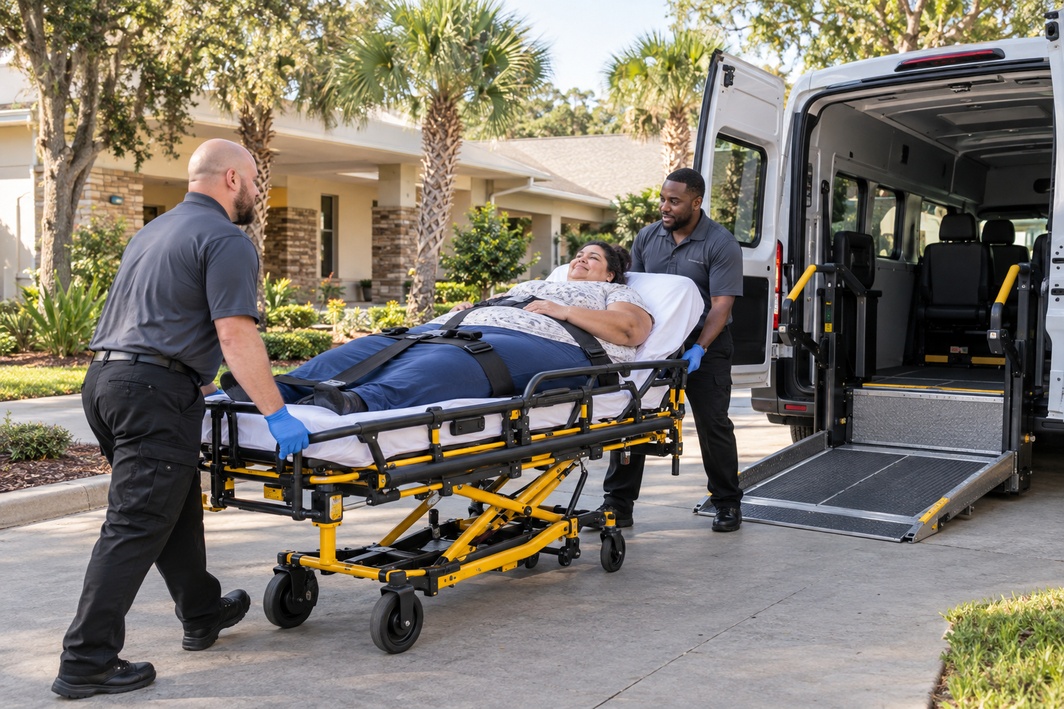
When a loved one cannot sit upright for a wheelchair ride and the transfer is not an emergency, the right answer is not an ambulance. It is a trained non-emergency stretcher transport team with the right equipment for the patient's needs. Comfort Ride Transportation serves Marion County families and discharge planners arranging safe, dignified stretcher transfers. Call (321) 804-5233 to schedule or ask questions about a specific transfer situation.
Families navigating a non-emergency transfer for a bedbound or bariatric patient face a gap that catches many people off guard: the patient clearly cannot travel in a standard vehicle, but calling 911 for a transport that is not a medical emergency feels wrong and often results in a bill that reflects the ambulance level of care rather than what the situation actually required. Non-emergency medical stretcher transport exists precisely to fill that gap, providing the equipment, the trained personnel, and the careful handling the patient needs without the emergency designation and the associated cost. Here is what that service involves and what families should know when arranging it.
When Is Stretcher Transport the Right Level of Care?
Stretcher transport is appropriate when a patient cannot safely maintain a seated position for the duration of the transfer, either because of a medical condition that requires them to remain lying flat, because pain or post-surgical status makes sitting upright contraindicated, or because the patient's size and weight make a wheelchair transfer unsafe or impractical. None of these situations requires emergency medical intervention during the transport itself, but all of them require more than a standard wheelchair-accessible vehicle can safely provide.
Common situations that call for non-emergency stretcher transport include discharges from hospitals or skilled nursing facilities where the patient is returning home but cannot yet transfer to a seated position, transfers between facilities such as from a hospital to a rehabilitation center or from one nursing home to another, and transport to outpatient appointments for patients who are bedbound at home or in a long-term care setting. In each of these cases, the patient is medically stable for transport but requires a lying position and trained assistance throughout the move.
Bariatric stretcher transport specifically addresses patients whose weight exceeds the rated capacity of standard stretcher equipment. Standard transport stretchers are rated for a specific weight limit, and exceeding that limit with standard equipment is a safety risk for both the patient and the transport team. Bariatric-rated stretchers and the vehicles equipped to carry them are designed for higher weight capacities and require teams trained in the specific handling techniques that bariatric transfers involve. Calling a transport provider that does not have bariatric-rated equipment for a patient who needs it is not a safe arrangement regardless of what the provider agrees to over the phone.
What Does Bariatric-Rated Equipment and a Trained Two-Person Team Involve?
Bariatric transport equipment starts with a stretcher rated for the patient's weight, but the equipment consideration extends to the vehicle itself. The loading system, the floor anchoring, and the interior dimensions of the transport vehicle all need to be matched to bariatric patient transport. A standard non-emergency transport van may not be equipped for this, and the difference matters from the moment the patient is positioned on the stretcher through the entire transport and the final transfer at the destination.
A two-person transport team is not optional for bariatric stretcher transfers. The physical management of a bariatric patient on a stretcher, including loading into and unloading from the vehicle, navigating through facility corridors, and managing any transfer between surfaces, requires two trained individuals working in coordination. A single attendant managing these tasks is a safety risk for the patient and the attendant alike, and any provider offering bariatric stretcher transport with a single-person team is not providing a safe service regardless of how the conversation goes when the booking is made.
Training for bariatric transport goes beyond general stretcher operation. It includes body mechanics and positioning techniques specific to higher-weight transfers, communication protocols between the two team members during lifts and moves, how to respond if the patient becomes uncomfortable or anxious during the transport, and an understanding of the specific equipment being used and its rated limits. A team that handles bariatric transfers regularly has developed the coordination and the physical technique that make these transfers smooth and dignified rather than difficult and stressful for everyone involved.
How Is Coordination With Sending and Receiving Facilities Handled?
A non-emergency stretcher transfer between facilities involves more coordination than a point-to-point ride, and getting that coordination right is what separates a transfer that goes smoothly from one that generates delays, confusion, and stress for the patient and the family. The sending facility needs to have the patient ready, their transfer paperwork complete, and their belongings organized before the transport team arrives. The receiving facility needs to know the arrival time and be prepared to accept the patient without a long wait in the vehicle after arrival. Neither of those conditions happens automatically, and a transport provider that does not actively communicate with both facilities before and during the transfer is leaving the coordination to chance.
We arranged a transfer for a family whose father needed to move between care facilities in Marion County. The family's primary concern was that the move be handled safely and with the dignity their father deserved. We coordinated directly with both facilities on timing, confirmed the paperwork requirements with the sending team, communicated the estimated arrival window to the receiving facility so they could prepare, and kept the family informed throughout the process. The father arrived at the receiving facility on schedule, without incident, and without the anxiety that comes from a disorganized transfer. That outcome reflected the coordination work that happened before the vehicle left the parking lot as much as the care that happened during the ride itself.
Discharge paperwork is a specific coordination point that affects the timing of the transfer and occasionally the transfer itself if documents are incomplete when the transport team arrives. A transport provider that has experience working with Marion County facilities understands what paperwork is typically required for different transfer types and can prompt the sending facility in advance about what needs to be ready, reducing the chance that the transport team arrives to find the patient ready but the paperwork not.
What Comfort Measures Make the Ride Safer and Less Stressful?
A non-emergency stretcher transfer can feel disorienting and vulnerable for a patient who is lying flat, moving through unfamiliar environments, and relying entirely on the people around them to manage the situation safely. The transport team's awareness of the patient's experience during the ride, not just their physical safety, is what determines whether the transfer is something the patient tolerates or something they feel genuinely cared for through.
Positioning and padding during the ride address the physical comfort concerns that a stretcher transport involves. A patient lying on a stretcher for a transfer of any significant distance needs adequate padding under pressure points, appropriate positioning for their specific condition, and secure but comfortable restraints that prevent movement during transit without creating additional discomfort. These are details that an experienced transport team manages as a matter of standard practice rather than as extras that require a specific request.
Communication during the transport matters as much as the physical care. A patient who is told what is happening before it happens, who knows roughly how long the ride will take, and who has someone speaking to them calmly throughout the transfer is a patient whose stress level during the transport is significantly lower than one who is moved in silence and uncertainty. That communication is part of what a trained transport team provides, and it is part of what makes the difference between a transfer that feels safe and one that simply ends without incident.
If you are arranging a non-emergency stretcher transfer in Marion County and need a team equipped and trained for the patient's specific situation, call Comfort Ride Transportation at (321) 804-5233 to discuss the details. Our medical transportation and handicapped transportation services are available for transfers that require more than a standard ride and less than an ambulance, handled by a team that takes the dignity of every patient seriously.